

MBA stands for Master of Business Administration. It is a postgraduate degree that focuses on business management, leadership, and decision-making skills. It is one of the most sought-after postgraduate management programs among students who have completed their graduation. An MBA is a widely recognized postgraduate qualification offered by universities and business schools in India and abroad. An MBA curriculum combines theoretical and practical learning through case studies, projects, presentations, internships, and industry interactions. Students get an opportunity to learn subjects such as finance, marketing, human resource management, operations, business analytics, economics, and strategic management.
MBA Course Review
| Particular | Details |
| MBA Full Form | Master of Business Administration |
| Course Level | Postgraduate |
| Course Duration | 2 years |
| Course Type | Degree |
| Eligibility | Bachelor’s degree from a recognized university |
| Admission Process | Entrance Exam or Merit-Based |
| Popular Entrance Exams | CAT, MAT, XAT, CMAT, NMAT, & SNAP |
| MBA Fees | Varies by institution and program |
| MBA Salary | Varies by institute, specialization, role, location, and experience |
| Examples of Recruiters | Deloitte, TCS, Infosys, Amazon, EY, KPMG, Accenture, HDFC Bank |
What is an MBA?
An MBA is a postgraduate management degree which helps students understand how businesses function and organizations operate. An MBA degree focuses on developing leadership, communication, analytical, and decision-making skills. The course combines classroom learning, practical projects, internships, presentations, and case studies. Students get to learn topics such as finance, marketing, human resources, operations, economics, and business strategies. MBA is widely recognized as a postgraduate management qualification that helps students attain managerial roles in both private firms and multinationals.

Why is an MBA Relevant in 2026?
An MBA (Master of Business Administration) is a two-year postgraduate management program specially designed to develop business, leadership, analytical, and decision-making skills. MBA courses prepare students for careers in management, consulting, finance, marketing, human resources, operations, and entrepreneurship.
Modern MBA programs, apart from traditional classroom learning, emphasize:
- Strategic Management
- Business Analytics
- Marketing Management
- Financial Decision-Making
- Human Resource Management
- Operations & Supply Chain Management
- Entrepreneurship
- Digital Business
In the present-day business environment, where AI is increasingly influencing how organizations operate, MBA programs are also adapting to these changes. Artificial intelligence is transforming the way organizations operate, while businesses continue to require professionals who can lead teams, make strategic decisions, solve complex problems, and drive growth. As AI continues to transform business, MBA programs are increasingly incorporating technology, data analytics and digital business concepts. Management professionals are expected to understand how AI can support decision-making, improve efficiency and create new business opportunities. As a result, combining management expertise with technological and analytical skills can help MBA graduates remain competitive in a changing job market.
MBA Eligibility Criteria
Students must satisfy the eligibility criteria set by the college or university before applying for an MBA program. The eligibility criteria may differ slightly across institutions, but the basic requirements remain the same.
The common MBA eligibility criteria are given as follows:
- Students must have completed their graduation from a recognized university.
- The minimum marks required for MBA admission are generally 50% for general category students and 45% for reserved category students.
- Students from academic backgrounds such as commerce, science, arts, engineering, pharmacy, agriculture and management are eligible to apply.
- Students who are in their final year of graduation can also apply for the MBA program, subject to submission of their final degree or marksheet in time.
- Many B-schools consider entrance exam scores such as CAT, XAT, CMAT, MAT, NMAT or SNAP, depending on the institution.
- Some colleges also include group discussion and personal interview as part of the admission process.
- Executive MBA programs may require prior work experience, with eligibility varying by institution.
- The students have to abide by the conditions of the respective college or university.
MBA Admission Process
The MBA admission process generally involves multiple stages, which are as follows:
Step 1: Entrance Examination
Students may need to appear for the entrance exams such as CAT, XAT, CMAT, MAT, ATMA, or MAH MBA CET, depending on the institution.
Step 2: Application Submission
Candidates must submit application forms to their preferred MBA colleges along with the required documents and entrance exam scores.
Step 3: Selection Process
The selection process includes the following, depending on the institute:
- Entrance Exam Score Evaluation
- Group Discussion
- Personal Interview
- Academic Profile Assessment
Step 4: Admission Confirmation
- Students who are selected must complete documentation and procedures related to payment of fees. Early planning can significantly improve admission opportunities and specialization choices.
MBA Fees
The fees for MBA Admission 2026 depend mainly on the institutes and locations. The fees charged by top IIMs (Indian Institute of Management) range from Rs 17 lakhs to 29 lakhs. For example, IIM Ahmedabad charges Rs 27.50 lakhs. Fees charged by top private colleges range from Rs 20 lakhs to 43 lakhs. For example, Indian School of Business (ISB), Hyderabad charges Rs 39 lakhs to 43 lakhs. Government institutes generally charge Rs 2 lakhs to 5 lakhs as fees for their MBA course. For example, MBA fee at the Faculty of Management Studies (FMS), Delhi is Rs 2.5 lakhs.
Popular MBA Colleges in India
The search for the best MBA Colleges in India is extremely common, as there is no universal list that works for every student. The rankings are based on different methodologies. There are some colleges that emphasize on academic reputation, while still others prioritize placements, research, faculty, infrastructure, perception or other indicators.
Students may consider the following institutions for admission into an MBA, which include:
| Institution | Factors Students Can Evaluate |
| IIM Ahmedabad | Academic reputation, leadership and corporate opportunities |
| IIM Bangalore | Strategy, entrepreneurship and industry exposure |
| IIM Calcutta | Finance, analytics, and management careers |
| IIM Lucknow | General management and corporate opportunities |
| IIM Kozhikode | Management education and diverse career paths |
| IIM Indore | Academic learning and corporate exposure |
| FMS Delhi | Value proposition and established alumni network |
| XLRI Xavier School of Management | HR and broader management education |
| SPJIMR Mumbai | Experiential learning and industry engagement |
| GNIOT, Greater Noida | Career-oriented management education and industry exposure |
This comparison is not meant to establish a definitive ranking. Instead, it demonstrates how students can compare different types of institutions according to their relevant factors.

MBA Specializations
The popularity of an MBA specialization depends on its salary potential, recruitment volume, and industry growth. Broadly, the most preferred and sought-after MBA specializations are divided into traditional specializations and tech-driven modern tracks. Specializations such as Marketing, Finance, and Operations are termed traditional, whereas Business Analytics, IT and Fintech are tech-driven.
There is a wide range of specializations that an MBA offers, allowing students to develop expertise in specific business functions. The most popular specializations are Finance, Marketing, Business Analytics, Operations Management, and Human Resource Management. Other specializations are Information Technology, International Business, Healthcare Management, Retail Management, and Entrepreneurship.
Career Opportunities after MBA
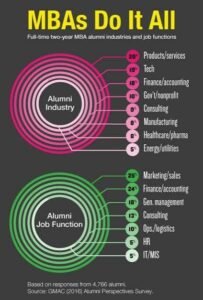
After completion, students can pursue a wide range of MBA career opportunities from many industries. MBA graduates are likely to gain many management, leadership, communication and analytical skills demanded by many employers. Many are curious to know about the career opportunities after completing the MBA course, which are plenty depending upon their specialization and interest. They can pursue employment opportunities in private firms, government agencies, startups, multinationals, consulting firms, banks, hospitals, IT firms, etc.
MBA graduates may find career opportunities with organizations such as Deloitte, EY, KPMG, Accenture, Amazon, Infosys, TCS, Wipro, HDFC Bank, ICICI Bank, Reliance Industries, Aditya Birla Group, Flipkart, Cognizant, Capgemini, and many other organizations.
MBA Salary
The MBA salary prospects depend upon various factors such as college, specializations, locations, skills, experience and company. Graduates from top business schools may earn higher salary packages than graduates from other institutions. MBA specializations such as finance, business analytics, marketing, and information technology can offer diverse career opportunities and competitive salaries, depending on the role, employer, skills, and experience.
| Job Profile | Indicative Salary Range (Per Annum) |
| Marketing Manager | INR 6-12 Lakhs Per Annum |
| Finance Manager | INR 7-15 Lakhs Per Annum |
| Human Resource Manager | INR 5-10 Lakhs Per Annum |
| Business Analyst | INR 6-12 Lakhs Per Annum |
| Operations Manager | INR 6-12 Lakhs Per Annum |
| Investment Banker | INR 5-25 Lakhs Per Annum |
| Finance Analyst | INR 5-10 Lakhs Per Annum |
| Digital Marketing Manager | INR 5-10 Lakhs Per Annum |
| Product Manager | INR 10-22 Lakhs Per Annum |
| Supply Chain Manager | INR 6-12 Lakhs Per Annum |
| Project Manager | INR 8-10 Lakhs Per Annum |
Note: Salary figures are indicative and can vary significantly based on the institute, specialization, job role, location, industry, employer, skills, and prior work experience. Candidates should refer to the latest placement reports and reliable salary sources for current figures.
Conclusion
An MBA remains one of the most widely pursued postgraduate qualifications for students seeking careers in management, leadership, business strategy, and entrepreneurship. The benefits of an MBA are immense irrespective of whether you are exploring its courses, eligibility, admission requirements, fees, specializations, or career opportunities. These factors, when well understood, can help you make an informed decision about your future. An MBA can support long-term career development, depending on the institution, skills, experience and career goals; therefore, students should evaluate factors such as curriculum, industry exposure, internships, certifications, placement support, faculty expertise, and return on investment before making a decision.
